
An international human rights organization has urged governments to ensure that decisions affecting members of Shincheonji Church of Jesus are based on verifiable evidence and established legal standards rather than public perception or unverified claims.
On July 9, Shincheonji Church of Jesus, the Temple of the Tabernacle of the Testimony, announced that the international NGO Coordination des Associations et Particuliers pour la Liberté de Conscience (CAP LC) had submitted a joint written statement to the United Nations Human Rights Council expressing concern over what it described as the growing spread of discrimination and stigma against members of the church.
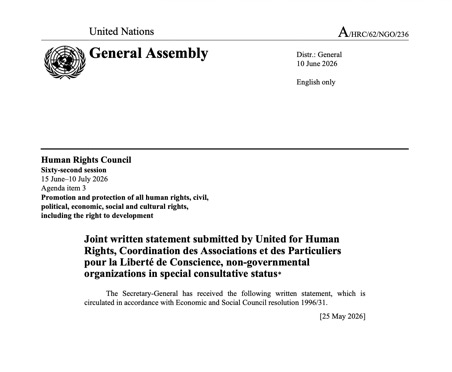
Excerpt from a joint written statement submitted to the U.N. Human Rights Council with CAP LC’s participation / Source: U.N. Human Rights Council
Rather than focusing on theological controversies surrounding Shincheonji Church of Jesus, CAP LC’s submission emphasized a broader human rights principle: that administrative and judicial decisions affecting religious minorities should be grounded in objective evidence and clear legal standards.
The organization warned that negative perceptions and unverified materials originating in South Korea, if accepted without independent verification, could influence public opinion abroad and ultimately affect government decisions, court proceedings and the everyday lives of church members in other countries.
Accordingly, CAP LC called on governments and public authorities to ensure that any actions concerning Shincheonji Church of Jesus are based on verifiable evidence and due process rather than social stigma.
Shincheonji Church of Jesus said the statement highlights a wider concern extending beyond a single religious organization. It argued that if unsubstantiated allegations are permitted to shape official decisions against one religious minority, similar standards could eventually be applied to other faith groups, reinforcing the responsibility of states to protect the rights of all religious minorities equally.

CAP LC, which holds Special Consultative Status with the United Nations Economic and Social Council (ECOSOC), has previously raised concerns before the United Nations regarding religious freedom issues, including the persecution of the Church of Almighty God in China and questions surrounding the Japanese government’s request for the dissolution of the Family Federation for World Peace and Unification (formerly known as the Unification Church).
According to Shincheonji Church of Jesus, CAP LC’s involvement demonstrates that issues surrounding the church are increasingly being viewed not merely as a domestic matter in South Korea but also through the lens of international human rights standards.
Cases Abroad Raise Concerns About Social Discrimination
CAP LC’s statement cited developments in the United Kingdom and German-speaking countries as examples of how negative perceptions of Shincheonji Church of Jesus members have allegedly extended beyond public debate into administrative decisions and social discrimination.
In the United Kingdom, the Charity Commission rejected Shincheonji Church of Jesus’ application for charitable registration, describing the organization as a “cult.” CAP LC argued that the use of such terminology in official administrative proceedings, despite lacking a clearly defined legal meaning, risks reinforcing social stigma.
The statement also referred to reports from Germany and other German-speaking countries, where church members have allegedly experienced workplace discrimination amid sustained negative public sentiment. CAP LC suggested that media coverage and a book published in 2025 by evangelical activists had contributed to deepening these perceptions.
Shincheonji Church of Jesus said these examples illustrate how unverified claims and persistent stigma can affect members’ employment, family relationships and broader participation in society. It reiterated its call for administrative and judicial authorities in every country to base decisions on objective evidence rather than public opinion.
Questions Over Religious Freedom and Political Participation
The statement also addressed ongoing developments in South Korea concerning allegations related to political party membership by some Shincheonji Church of Jesus members.
CAP LC argued that participation in political activities should not be treated as inherently suspicious simply because individuals belong to a particular religion. It called on the South Korean government to uphold the principles of religious freedom, non-discrimination and state neutrality toward religion.
The issue arises amid an ongoing investigation by South Korean authorities into alleged violations of the Political Parties Act. On June 24, a court issued an arrest warrant for Shincheonji Chairman Lee Man-hee, citing concerns including the possible destruction of evidence. On June 29, prosecutors indicted Lee while he remained in detention.
While acknowledging that the legal process remains ongoing and that the courts will ultimately determine the outcome of the charges, Shincheonji Church of Jesus maintains that the case should be assessed solely on objective evidence and through due process rather than public sentiment or political controversy.
The church has also questioned the necessity and proportionality of Lee’s continued detention, noting that he was born in 1931, has cooperated with investigators and that key evidence had already been secured through search and seizure procedures.
A Broader Test of Religious Minority Rights
According to Shincheonji Church of Jesus, both the discrimination cases cited overseas and the ongoing investigation in South Korea raise a common question: what standards should governments apply when dealing with religious minorities?
The church argues that the issue extends beyond one religious organization and has become a broader measure of whether legal systems apply principles of equality, due process and religious freedom consistently.
It said the international attention generated by CAP LC’s statement reflects growing interest in whether judicial and administrative authorities, both in South Korea and abroad, will continue to uphold legal standards based on objective evidence rather than public perception.
Ultimately, Shincheonji Church of Jesus said the outcome of these cases will serve as an important indicator of how effectively democratic societies protect the rights of religious minorities and maintain public confidence in the impartial application of the law.

SCJ is an abbreviation for Shincheonji. SCJ TV is the official broadcasting channel of Shincheonji Church of Jesus, the Temple of the Tabernacle of the Testimony. As a global media platform featuring worship, Bible education, teaching, and cultural content, SCJ TV aims to make its Bible-based teachings accessible to audiences worldwide, transcending geographical and linguistic boundaries.
Website : https://www.shincheonji.org/en
Contact: press@scjtvglobal.com